Saturday, September 30, 2017

Pronouns and BINGO!


Sometimes the most successful ideas pop up when you least expect them! That happened this week while we were playing Apple BINGO! The plan was to work on pronouns HE and SHE while we played the game. Instead of using pictures to elicit the trials we grabbed the Grandma and Dad dolls out of our apple orchard sensory bin! They perfectly held the calling cards from BINGO and the child got to decide where to place the card. As he placed them in their lap, he practiced "She has the apple pie" or "He has the apple juice". So simple!!! It was engaging and natural. The vocabulary was also rich in sibilants so we were able to target articulation within the game as well.  It's a good day when your simple game allows you to easily address syntax, articulation and vocabulary!! 

Looking for an apple BINGO? you can find one here :)

Thursday, September 28, 2017

Apple Themed Sensory Bin


Our kiddos are jumping right in to our sensory bin this week! We put a bean/pea/pasta mixture together and added props. Cups and straws for pretend apple cider, little white flowers for apple blossoms, small trees, plastic apples, toy pies, a basket, doll family, a ladder and our vocabulary cards. Our Chicka Chicka Boom Boom Coconut tree also gets some extra mileage as an apple tree! We just got a little creative with velcro on our plastic apples. This really promotes some flexible thinking and creativity with some of our rule-governed, concrete thinkers :)


Throwing such a variety of items in the bin allows us to target a variety of goals at once with more than one friend. We can jump between auditory directions, motor imitation, articulation, vocabulary, semantics, memory and concepts just to name a few and do it all through play. 


Here we were pretending to be in the orchard with our family. The kids had a lot of fun pretending to climb up..up...up the ladder to pick apples off the tree. Then we climbed down...down...down...and put them in the bushel basket.  If our friends had a hard time incorporating trials within play, we used the sensory bin as a reinforcer following some work trials with our hands out of the bin.  It's amazing how reinforcing a sensory bin can be!!


Pretend play, demonstrating actions and labeling actions were fun with a slice of pie and our little family. 

 We love creating new sensory bins. We just have to be mindful of allergies. This bin was so easy to put together and we are loving how many skills we can cover with little hands in the bin :)

Saturday, September 23, 2017


Happy Fall Y'All!!


Fall is one of our favorite seasons! The trees are beginning to change and we see pumpkins and apples everywhere! We've been using apples in our therapy for the past week.  Apples! Apples Everywhere! We love to use real apples and props in our therapy. Integrating song, manipulatives, apple pie play doh and games into our therapy make each session so much fun.  

This week, we are excited to share a few apple themed activities with you! Here is one that we used last week and we can't stop singing it!

We love to use melody in our therapy sessions. Repetitive vocabulary and rhyme paired with melody are great methods to learn concepts and new vocabulary. We wrote this story to the tune of Take Me Out to the Ball Game. The story uses this melody to incorporate vocabulary like orchard, trees, ladder, bushel basket, apple sauce, apple juice, apple pies and size/color concepts.


We've made interactive books for many years and always used velcro. Not any more!!! We use Aleen's Tack-It  glue to make our vocabulary props interactive throughout the story. We stick them in the book, on the wall, table or dry erase boards! Thanks for the tip Jenna Rayburn


For our kiddos working on articulation, we are able to target many goals using the interactive book! We highlighted our target speech words in the take home version of the story for carryover practice at home. This story especially provides a lot of practice for kids working on /L/, /S/, /R/ and multi-syllabic words.

Mini bushel baskets and apple holiday decorations make the theme come alive. We love to shop for props after the season :) We simply cut off the strings from these apple Christmas tree ornaments! The apple pie that we have propped up on the basket is really a dog toy! Keep your eye out while you're shopping! You never know what you can find to use for therapy!!!


Need a new story for your apple unit? You can grab it here:  Take Me Out to the Orchard Interactive Story

Check back daily this week for more fun ideas using an apple theme for therapy!!!
Apple Themed Activities from Candy Apple Speech


Thursday, August 3, 2017

8 Reasons to use Play Dough in Therapy!


As we all know, children love all things Play Dough! Any time the word Play Dough is mentioned, the excitement on their faces and in their voices says it all! Because Play Dough is such a highly preferred activity for the children, we have jumped on board with using it in therapy and find it to be an activity that has so many benefits! Here are 8 reasons why we love using Play Dough in therapy! 
We see an increase in spontaneous language/requesting while playing. As the children are sitting at the table playing with the play dough,  they are able to generate so many different words and phrases. Many different types of requesting can be practiced during Play Dough time whether you are working with a child 1:1 or in a small group.  If the child is working on requesting motivating items that are in sight, you can keep the Play Dough and various different Play Dough toys on the table and let them request. Models or cues can be provided as needed. If they are working on requesting items that are not in sight, you can keep the different colors and toys in box below the table. It is also a great way to work on the children cooperatively playing and requesting a reinforcer that another child might have. 

It is extremely motivating. "Play dough is boring," said no kid ever. Other than a child who has sensory aversions to certain textures, we have never experienced a child who came into our therapy room and turned down the opportunity to play with play dough. They are able to use their imagination to create various things with the play dough and even use dialogue to pretend play with their peers. 

It naturally elicits vocabulary. Children are able to use so many different types of words while playing with Play Dough, which include nouns (scissors, knife...), pronouns (me, him, she, we...), verbs (cut, smash, roll...), attributes (color, shape, size...), concepts (under, on top, next to...)...and the list goes on! Bottom line is, Play Dough is a naturally vocabulary rich activity. 
Rhythm & Rhyme. The use of rhythm and rhyme in therapy help the children to learn and remember things that they hear. They love interacting with their therapist and peers during hands-on activities where they can sing along or predict what comes next in the rhyme. Memory and melody are frequently paired in our therapy room.  We love making up songs that the children can sing along to or provide a fill in the blanks. It is amazing how much the children can pick up with the use of a little repetitive song. The best part is that no matter how horrible you think your voice is, the children will absolutely love it!                                                                        
It is great for fine motor and bilateral coordination. Play Dough is a great activity that can work on strengthening the little muscles of the hand. Children can put beads or other small objects in the Play Dough and work on pinching their fingers together to get them out. Rolling, smashing, cutting, and squeezing are all different actions that require use of fine motor skills.  When playing with play dough, the children are naturally required to use two hands. Therefore, their hands are each crossing midline at given times to knead, roll, or cut the play dough. Bilateral coordination is essential to making sure that both sides of the child's body are communicating. This also helps a child develop an awareness of where their body is in relation to space or various things around them.

It is multi sensory. While playing with Play Dough, the children are not only using their sense of touch. They are using almost all of their senses. They use their sense of touch to feel the Play Dough and smell to smell the Play Dough. We have a lot of fun creating dough with scents appropriate for our current theme in therapy.  They use sight to look at the play dough as they play as well as for hand eye coordination as they make various things out of the Play Dough. They use hearing to listen to what is going on around them; to listen to  their therapist and to listen to what the children are saying around them as they play. The one sense we highly discourage the children from using is their sense of taste... nobody wants a taste of germy Play Dough.


Use of SMASH mats. This is such a fun way to work on various skills while playing with play dough. We have created various types of smash mats, which include vocabulary, speech sounds, letters, numbers and counting.   Specific goals can be targeted and work can be done through this kind of play without the child feeling like it's work.


It is fun! Our goal of therapy should always be to make it fun for the child. A child who is engaged with you and is having fun without knowing they are working on therapy goals will perform much better than a child who is not engaged or is bored with what you are doing. Always, always, always make therapy fun! Play dough is a great way to do this!

This wraps up 8 reasons to use play dough in therapy. However, we would love to give out a freebie that we think you might all love using in therapy! As mentioned as our #7 reason, we love using smash mats. For those of you that aren't familiar or don't know where to find one, here is a freebie! All you need to do is print & laminate it and you will be ready to use it in therapy. If you love them, you can also check out the thematic smash mats on our TPT store which we have made to go along with different thematic units! You can grab our freebie here --> Smash Mats FREEBIE!

Go grab some Play Dough and have a great day! :)

Sunday, July 16, 2017

10 Reasons We Love Our Speech Therapy Room


In all our years of practicing, we have had a wide variety of therapy spaces to call home.  We've had small closets, large closets, part of the office, shared space with other related services, the hallway,  a rolling cart, a table in a regular education room, our car trunk, and even an unused stage in the gym.  As SLP's we believe we're a pretty flexible and creative bunch of folks.  We make the best of what we are given and do our job.  For the past ten or so years, four of us have called this space home.  In fact, we refer to it as 'The Speech/Hearing Suite" as it is occupied by 3 Speech Pathologists and 1 Hearing Impaired Itinerant teacher.  It wasn't always easy, but we certainly made it work from a therapeutic stand point.  Over time, our room also morphed into a cozy environment that was functional and a relaxing place to work. While we could easily generate a list of what we DON'T like about our space (no sink, no windows, no control over the heating/air)...it is much more productive for us to share 10 things we DO like about our room in hopes that it may spark an idea or two for someone else's therapy room/classroom.  So here it is!!! The top 10 reasons we love our therapy room!


10. Wooden letters on our bulletin board

Our mantra is 'Speech is Always Fun' so we simply bought letters from Michaels and painted them in our color scheme and hung them on the wall! The truth is...they kept falling so we used a low temp glue gun and glued them to the material on the bulletin board :)  

9. Scrapbook paper in our Sterilite drawers

This was a perfect way to hide all of our thematic materials we store in the drawers. We bought 12x12 scrapbook paper in our color scheme, trimmed it to size and just slid it in! Super simple! It hides what's inside and gives a clean, colorful look to the room. 


8. A curtain to hide our games

We tucked our game cabinet between two wardrobe cabinets and purchased an inexpensive cotton curtain from Wal-Mart along with a tension curtain rod.  After trimming a few inches off the bottom we hung it up! It minimizes distractions while we are working near by.

7. Material on our bulletin boards

It's amazing what you find in the remnant bin at a fabric store! We covered our boards with material instead of paper and it lasted us for years. It doesn't ever fade, matches our theme and provides a little color pop on the walls.

6. Gutters to hold story telling props

One of us may or may not have a slight obsession with props for children's books.  Gutters that were screwed into the wall by our custodian hold these little guys as well as the book! Ours were installed up higher for adult hands to bring them down as needed but we have seen them installed under a dry erase board/chalk board so that little hands could use them while they read.  


5. Cabinets to hold our toys

We are lucky enough to have some larger wardrobe cabinets in our room that holds the toys for all of us. Typically, we rotate the toys that are within reach of our kiddos and hide the rest behind closed doors.  It definitely helps us maintain structure and provides for wonderful communication opportunities with we give them a sneak peek behind the door!


4. Decorations from the ceiling

Super simple decor! These are just paper flower balls that were purchased at a local party supply store.  Throughout the year we also hang other thematic props like snowflakes, butterflies, peppermint sticks, apples, etc.  It is not only whimsical, but it helps some of our kiddos learn to scan the environment in all planes.  It also sparks spontaneous language.  

3. Desks along the wall

We maximized the productive work/play space in this small room by eliminating 4 large teacher desks.  An inexpensive laminate counter top was affixed to the wall and rested on 4 two drawer filing cabinets to hold it up.  We found that our Sterilite storage drawers also conveniently fit under the cabinet as well.

2. Curtains!!!!

This was one of the best things we added to our room.  Above our desks there are long shelves filled with therapy materials.  It is so visually overstimulating so we decided to soften the look with sheer mosquito net type curtains from Ikea.  They were really long so we cut off about three feet and tied some ribbon around the bottom. They are hung on inexpensive Ikea rods and hooks that are meant for drop ceilings.  Yes, they came up and down a couple times a year for washing but we had a good system for putting them up and taking them down.  The polka dot garland was purchased quite a few years ago in the college decor section of Target.  It is amazing how EVERYONE notices the busy shelves when they come down but they are softly hidden when the curtains go back up.  


1. Lamps!!!

The number one reason we love our room is because we NEVER TURN ON THE LIGHTS!!! Our room is lit by lamps alone. Many lamps provide a nice warm home-like glow in our room and we truly believe has cut down on our headaches from the fluorescent bulbs.  

So there you have it! Our top 10 reasons we love our room!!! We have some news though!
We are passing this room on to our social worker friends and moving to a different room in the building.  It was a tough decision to leave this beautiful little room. However, we are lucky enough to be moving to a room with a sink, thermostat and WINDOWS!!!! Stay tuned to see what we have up our sleeves for our new therapy space in the fall :)

Sunday, July 2, 2017

Just Add Water!!!

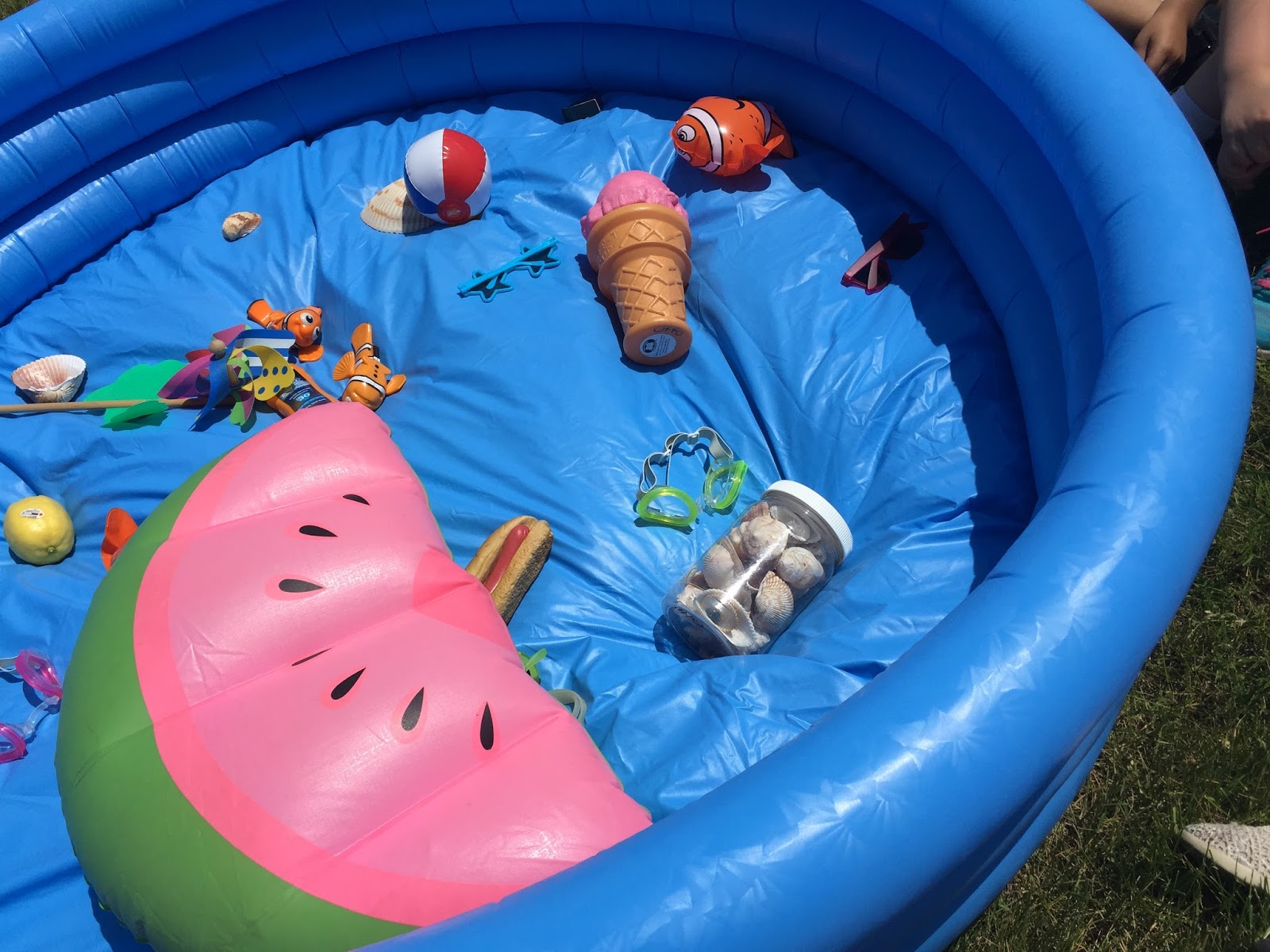
You know what always pulls our kiddos into a lesson? WATER!! It doesn't matter how we use it! We could spray it, mist it,  pour it, freeze it, splash it, or paint with it! The list goes on and on! This summer, we have been playing with water in a couple of ways.  We blew up a pool for some out door fun....

and used a small bin for some table top fun...

 Not only does it naturally provide hands-on opportunities for concept development like WET/DRY, WARM/COLD or SINK/FLOAT it also allows you to work on action words like POUR/DROP/SPILL/SPRAY/SPLASH/ SPRINKLE/STIR/ etc.

When you use water activities in an instructional manner, you can create multiple opportunities for functional communication starting at the most basic level.  We may play with water for a short while then remove it from the child's reach or put our body between the pool and the child. Whether the child is learning to point, sign single words, use a picture exchange, voice output device, single words or sentences, this creates a natural opportunity to request water play again.

We pulled some actual summer time common objects/props to toss in the pool. Items like: beach balls (of various sizes), pinwheels, bubbles, a lemon, seashells, toy fish, pretend hotdogs/ice cream/watermelon/, sunglasses, goggles etc.


We made some predictions if they would sink or float then threw them in! Using props like this make vocabulary work a breeze! The kiddos can identify and label objects as well as target semantic skills like features, functions, class and association.  Parents can easily duplicate a lesson like this at home in the back yard or even in the tub.

Looking for a color/cut/glue activity to complete with your little ones as a follow up to an activity like this?


Download it for free here!Summer Craftivity FREEBIE


Monday, June 12, 2017

BINGO... It's More Than Just a Game

SLP: "Let's play BINGO today in speech."
Child: "Yes! I love to play games in speech!!"

In the eyes of a child, BINGO is a fun game they can play... In the eyes of a therapist, BINGO is so much more than just a game the children can play. BINGO affords the child a host of skills to develop while playing a game! A thematic game of BINGO can build their receptive and expressive vocabulary as well as increase their ability to describe, interact with peers, work on turn taking, tolerate winning vs. losing and visual scanning, just to name a few.

Vocabulary BINGO is one of our favorite products to make as well as play within our therapy sessions. It is a fun and easy activity that can be adapted to work with children in EC all the way through our students who are in 5th grade.

For children in EC, differentiating instruction based on ability level is key. Some students may only be working on being in proximity of peers, increasing structured work time or even picture to picture match. For others, we might label and then show them the picture of the object they need to find. We can place the large calling card picture close to their card to help them scan and find the match. Some of the children might only require you to say the object name once and they can find it while others might be dependent on a visual to find the object. After finding the picture, depending on the level of the child, you might give the child a model and have them repeat after your model. You might also ask the child what it is and have them label the object without your direct model. BINGO can be tailored for kiddos that have a broader vocabulary base by talking  about some of the features, the function, associations or the class of the object. For example, you might ask some of these questions about Watermelon: What color is watermelon? What do you do with watermelon? What goes with a watermelon? What category does watermelon belong to? These are just some examples of how vocabulary BINGO provides exposure to thematic vocabulary while playing a game, for children across various levels of development.


For older students, BINGO is fun to use as a describing game. Each student takes a turn choosing a picture from the calling card pile. They are not able to show their peers the card but, instead, they have to describe the object in their hand. For example, if they choose a picture of ice cream, they might say, "It is a dessert that is cold. It can melt if you don't eat it quick enough. It comes in a bowl or on a cone. It comes in many different flavors." The students are NOT allowed to guess what the object is until the other student gives 2/3/4 clues. This is a great activity for the children to all work on expressing details or formulating a definition as well as for listening for details and comprehending clues that are given. You wouldn't believe how challenging it is for some of the students to inhibit themselves from blurting out the object until the other student is done giving clues!

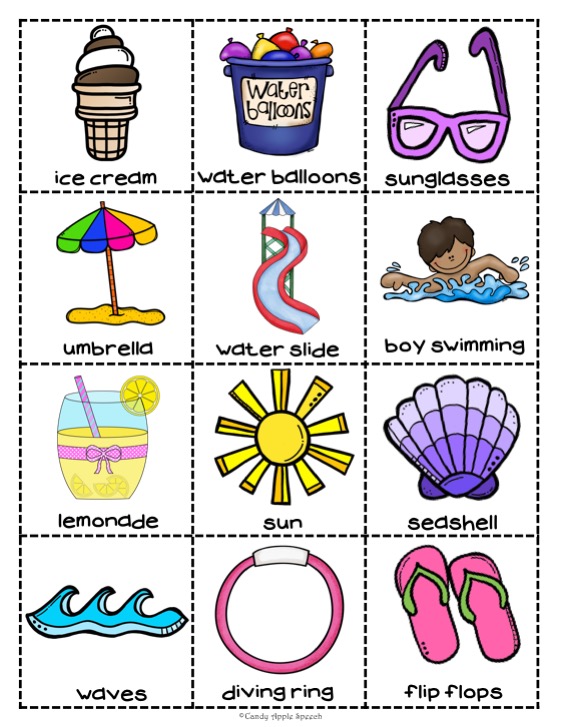
For those of you teaching summer school, Summer BINGO is up on TPT now! →Summer BINGO on TPT

For those of you who are enjoying summer break, check back at the end of summer for our other vocabulary BINGO games!

Happy Monday, y'all!